Dogs
The Heart of a DogDogs in the story occupy both sides of a sharp boundary: they are independent observers of human life, equipped with senses and knowledge their human counterparts underestimate, and they are vulnerable bodies over which humans claim scientific and social power. Sharik’s passage from a burned, hungry stray to the subject of an unprecedented transplant gives that boundary its most consequential test. His canine experience does not disappear when he begins to speak; it supplies the memories and street language through which the experiment’s human outcome takes shape.
Canine Knowledge and the City
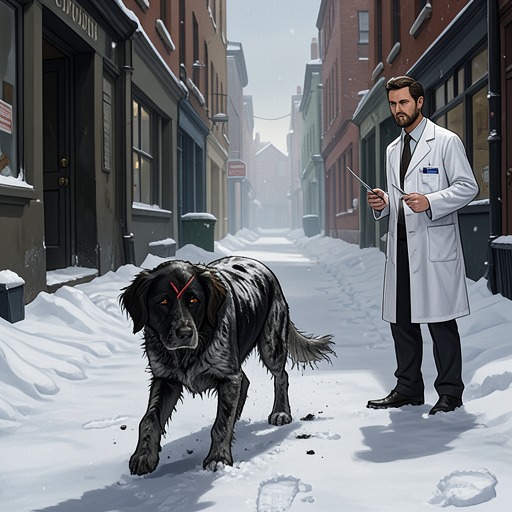
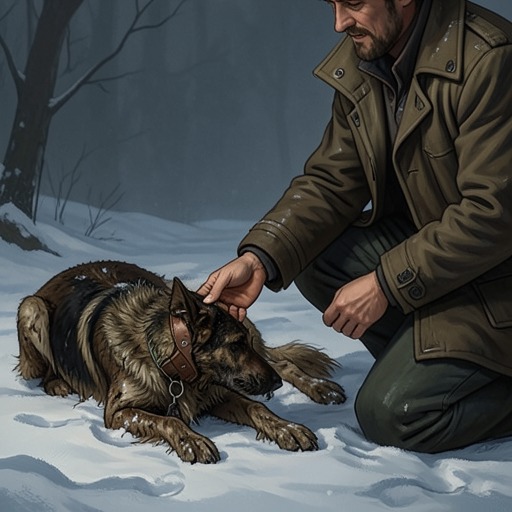
The narrative introduces canine life through Sharik’s bodily distress. Scalded on the left side by boiling water spilled by a cook at the National Economic Council canteen, he lies in a doorway as a snowstorm howls around him. His account measures Moscow through hunger, pain, and smell: onion soup from the Prechistenka fire station marks the afternoon, while a report from dogs he knows points toward a restaurant serving mushroom stew. This knowledge is practical and local, formed by survival rather than by human institutions.
Dogs also make sense of the city through signs, though smell remains their first guide. Sharik argues that a dog in Moscow can learn to spell “sausage” without night school; he recalls recognizing blue-green shop signs for the Moscow State Food Stores and misreading one when car exhaust obscures the smell of meat. The blue sign leads him into an electrical goods shop, where the Polubizner brothers teach him about insulated cable by painful example. He then refines his reading of butcher-shop signs by noticing the distinctive shape and color of their first letter. The episode presents canine learning as observation accumulated through error, not as a simple absence of intelligence.
That intelligence includes a keen reading of human conduct. When the gentleman who finds him examines his injury, Sharik identifies the source of the scald through a look and a whimper; the man correctly sees a burn rather than lice and orders Zina to take him to the consulting room. Sharik’s account can therefore convey both an animal’s limited access to human speech and the expressive force of gestures that humans interpret. The dog is not simply looked at: he watches, remembers, judges, and communicates.
Shelter, Collar, and Social Status
Sharik’s new surroundings change his physical condition and his position in the household. After a week with Professor Preobrazhensky, a case record describes him as extremely well nourished and weighing eight kilograms, in contrast to his previous poor condition. His recovery does not make domestic life uncomplicated. When he claws at the carpet and is dragged over to have his nose rubbed in an owl, he weeps and thinks that he can endure punishment if only he is not thrown out. His fear of losing shelter remains legible beneath the comedy of the household’s discipline.
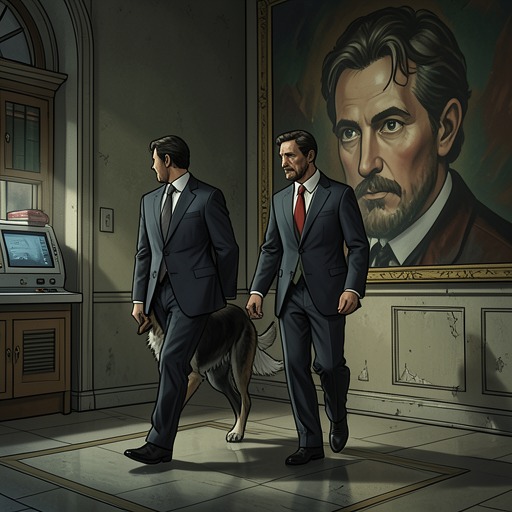
A collar makes the altered status visible in public. At first Sharik sees his wide, shiny collar in a mirror, puts his tail between his legs, and retreats to the bathroom, intending to rub it off against a box or basket. On a lead with Zina, he walks along Obukhov Street as if under arrest, ashamed of the object. But the reactions around him teach him its social meaning: dogs he meets look at it with envy, a shaggy mongrel calls him a master’s pet and lackey, and a policeman regards it with approval and respect. On their return, Fyodor the porter opens the door for Sharik himself and remarks on how much the dog has changed since Professor Preobrazhensky brought him home. The collar signifies both dependency and privileged access; it changes how people and dogs treat him without changing the fact that he is being led.
The Transplant and the Humanized Animal
The experiment subjects canine bodies to a decisive intervention. On December 23, Professor Preobrazhensky begins what the case record calls the first operation of its kind in Europe: under anaesthesia, Sharik’s testicles are removed and replaced by human testes taken from a man who had died four hours and four minutes earlier. The surgeon then trepans the skull, removes the dog’s pituitary gland, and replaces it with a human pituitary from the same donor. The scientific procedure makes the animal’s body the site where the human and canine are forcibly joined.
The account of the experiment’s aftermath emphasizes that the new speech does not arrive as knowledge detached from Sharik’s past. In a case-note entry, the first words reported as connected to surrounding events answer a rebuke about throwing food scraps on the floor with an insult. The doctor recording the change interprets the pituitary as having activated the speech center in a canine brain and proposes that the brain developed rather than being newly created. He further hypothesizes that Sharik had accumulated a store of sensory data during his canine life, including the street language that now pours out in speech. These are the observer’s scientific interpretations, not proof that the experiment has made the animal a blank human subject.
The same account suggests that dogs exceed human expectations in more than one faculty. Sharik can read, a capacity the observer recognizes after his early use of the word “delicatessen”; the observer speculates that canine visual anatomy may explain it. What the record treats as a revelation is also a reappraisal of what had been present all along: the dog already possessed perception, memory, and learned associations. The operation gives these capacities a startling new outlet, but the narrative’s evidence of them begins in Sharik’s life before surgery.
Meaning and Limits of Canine Subjectivity
Sharik’s point of view makes the animal a comic and critical interpreter of human society rather than a mute emblem. His judgments about food, labor, signs, streets, and status arise from concrete dependence on human arrangements, but they are not reducible to those arrangements: he has preferences, remembers pain, fears expulsion, and learns from mistakes. His movement between a doorway, a household, and a medical procedure also exposes how quickly care can shade into control. Shelter and nourishment save him from immediate deprivation, while the same domestic and scientific setting permits humans to handle, discipline, and transform his body.
The experiment’s claims to create a new human entity are complicated by the persistence of the canine past within the transformed creature. The observer’s own hypothesis places Sharik’s stored sensory experience and street language at the foundation of his speech. Dogs therefore matter to the story not just as a contrast to humanity, but as beings whose intelligence and experience precede, and survive within, human efforts to define them. Sharik’s transformation makes the animal–human boundary visible precisely because it cannot be treated as a clean division between an empty animal body and a wholly new human identity.